
Peaucellier–Lipkin Linkage
Consider the device shown in the animation below. It consists entirely of rigid rods joined at pivot points.
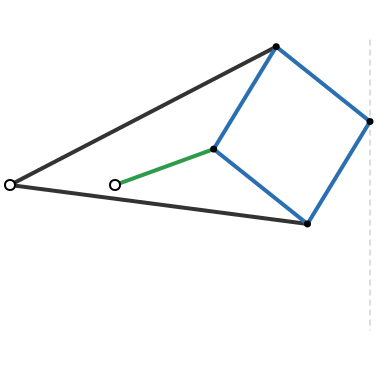
It is called the Peaucellier–Lipkin linkage, named after Charles-Nicolas Peaucellier, who invented it in 1864, and Yom Tov Lipman Lipkin, who discovered it independently in 1871.
It has the special property of transforming rotary motion into straight-line motion, and vice versa. This post examines why this works.
Let us first introduce some parameters. Let the two long black rods have length . They are joined at the anchor point . Each rod of the blue rhombus has length . The green rod is anchored at , at distance from , and has length as well.
We start by considering the long rods and the rhombus by themselves. We will require that , which makes the rhombus fit inside the two long rods.
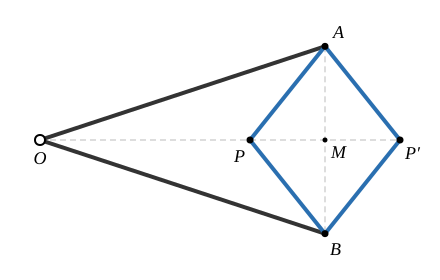
The long rods join to the points and , and the rhombus is . The midpoint of the rhombus is denoted . The diagonals and of the rhombus are perpendicular and bisect each other at . Since is equally far from and , it lies on the perpendicular bisector of , which is the line through and .
Using the Pythagorean Theorem on the right-angled triangles and , we get and . Then we have
Since , we have , so lies outside the segment and and are on the same ray from .
The two factors and are therefore the distances from to the closer and the farther of the points and . The product does not depend on which is which, so the relation holds whether is the closer or the farther of the two. This means that the points and are each other's (circle) inverses.
Now for the green rod. It joins to the anchor point , and since , the point is constrained to move on the circle with center and radius , which passes through . Let be the point on this circle opposite , so that is halfway between and , and let be the inverse of . Now let be anywhere else on the circle, off the line.
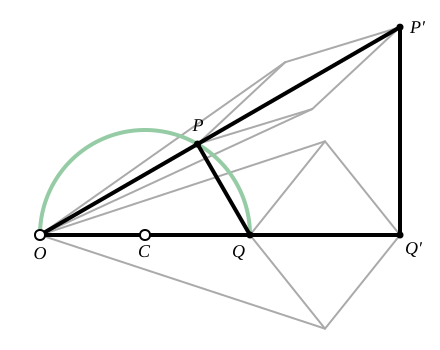
We have and thus
Since lies on the ray and lies on the ray , the triangles and share the angle . This proportionality and the shared angle imply that the triangles and are similar.
Now for the final part: Since is a point on the circle where is a diameter, the angle is a right angle by Thales's Theorem. From the similarity we then have that is a right angle. And since was chosen arbitrarily (off the line), this will be true for any position of on the circle.
So always lies on the line through perpendicular to . In other words, as moves on its circle, moves on a straight line, at distance from .
You can also explore the linkage interactively in the lab.