
The Poisson Problem
The Poisson equation is one of the most important partial differential equations (PDEs) in applied mathematics. Given a domain and a source term , the Poisson equation seeks a function satisfying
where is the Laplacian of . The negative sign is a convention that makes the operator positive definite, as we will see later. It arises in numerous areas of physics and engineering, including electrostatics, gravitational potential, heat conduction, and fluid mechanics.
To obtain a unique solution, the PDE must be supplemented with boundary conditions on . The boundary is typically partitioned as (with no overlap, ), and two types of conditions are imposed.
Dirichlet boundary conditions prescribe the value of the solution directly:
Neumann boundary conditions prescribe the outward normal derivative (flux):
where is the unit outward normal to . When , the condition is called a zero-flux or natural condition.
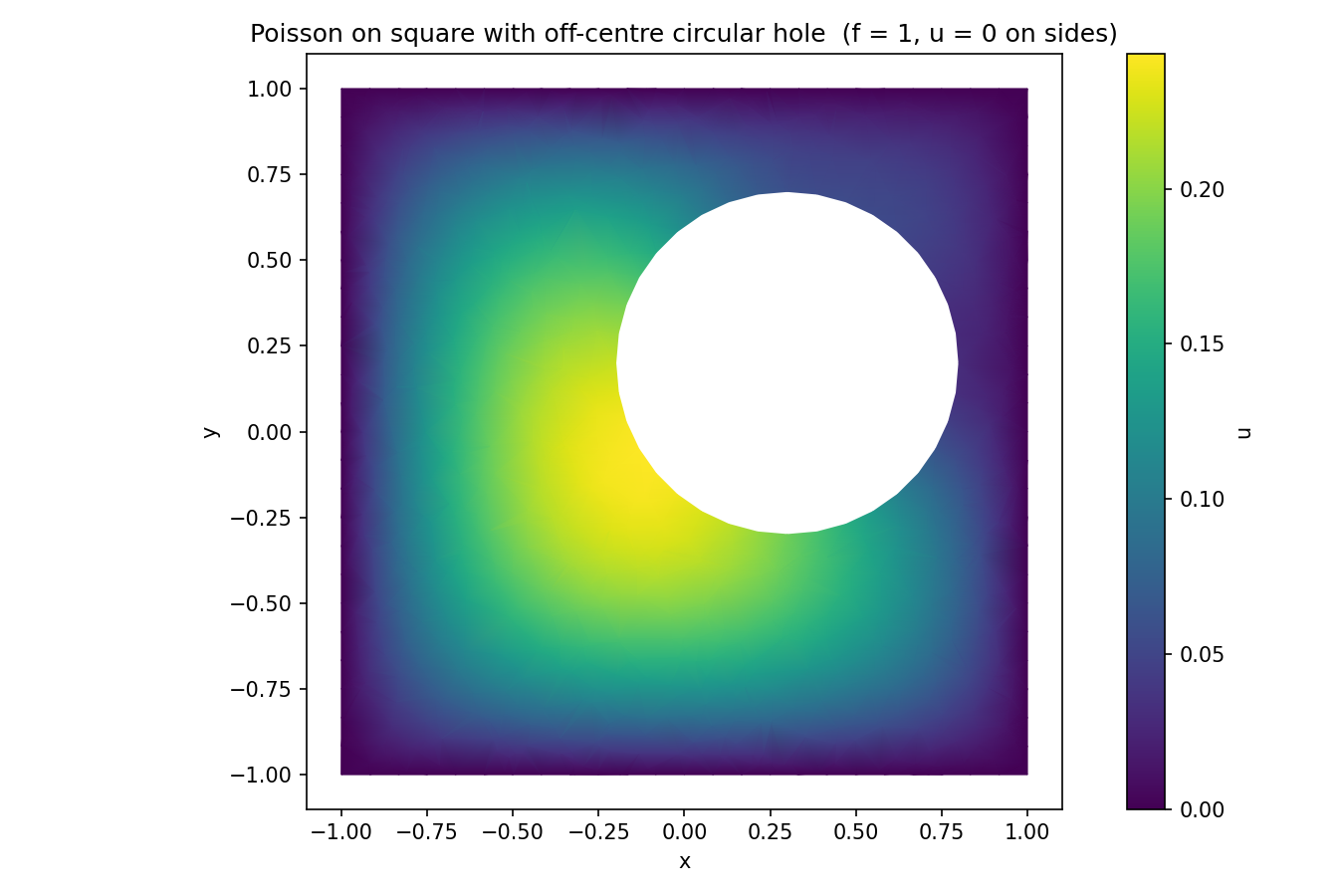
Consider a square domain with an off-centre circular hole of radius centered at . The outer square boundary carries a homogeneous Dirichlet condition , while the circular boundary carries a zero-flux Neumann condition . The source term is .
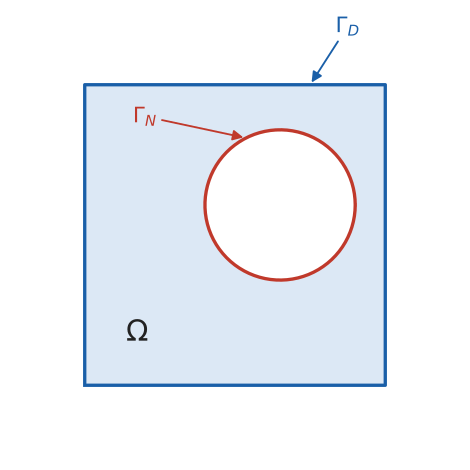
Solving this problem — using the finite element method developed throughout these posts — gives the solution shown below.
In one dimension the Poisson equation on with and homogeneous Dirichlet conditions reads
Integrating twice and applying the boundary conditions gives the exact solution
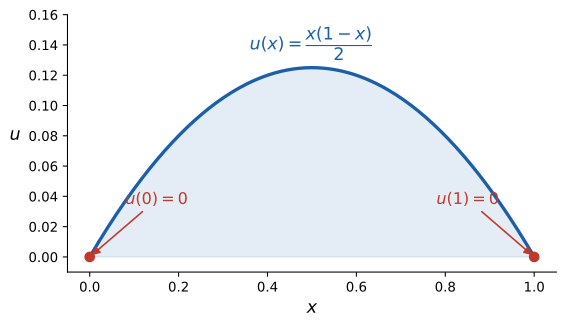
This simple example will serve as a useful reference throughout the series: it is easy to verify computed approximations against the exact parabolic profile.
The Poisson equation is only the simplest member of a much larger family. The next post generalises it to general elliptic PDEs, where the Laplacian is replaced by a second-order elliptic operator with diffusion, convection, and reaction terms.